Wednesday, 6 June 2012

The Eightfold Path: Right livelihood (Part.1)


How is it that I manage to take a fairly straightforward topic and ramble on about it for pages and pages?!? I was pretty convinced that Right livelihood would require half a page and be done. How wrong I was! In this blog post I explore right livelihood in its typical Buddhist format, and then I look at the relationship between affecting change on our lives and dealing with life circumstances as they are, and in particular how this plays out in the world of work. The first part then will cover the Buddhist issues of right livelihood concerning job selection and our contribution to the world through how we make a living. For those of you who've found my take on the world of Buddhism stimulating to some degree, the second part of this blog post will explore the relationship between the self-development field and Buddhist deconstruction of the self.

Let’s get started then
Right livelihood is an extension of right action and right speech. It therefore concerns the way we interact with the world and in this case how we interact with work. In a way this step on the eightfold Path is relatively straightforward. There are two questions that we need to ask ourselves in relationship to the work we do;

Does the way I earn money and make a living contribute to suffering in this world?
Does my work support my practise and provide conditions in which I can actually practise as I need to?

If the answer is yes to the first, your work may fit into one of the following categories. There are the classical definitions found in most traditions for determining wrong livelihood.

1.      Selling arms, or dealing in weapons and instruments of death and torture
2.      Dealing in slavery including prostitution (I would add slave labour too)
3.      Dealing in meat including raising cattle for meat, slaughtering & butchering
4.      Selling alcohol, drugs, or poison (does this include tobacco?)

In looking at these definitions of wrong livelihood, it seems that we can make a clear distinction between the first and the last two. Yet, even in exploring the first two there is ambiguity and I can’t help but feel that a decisive split from associating ourselves with these two potential forms of livelihood seems to be an expression of both excessive idealism and naivete. As general guidelines, they are on point, but as is almost always the case, there will be exceptions to the rule.
It is sometimes said that what you do is determined to be good or bad based on your intention. I think this is a problematic approach that potentially leads to a form of excessive permissiveness. So, as per usual, there is a need to find a healthy middle ground in weighting up facts and options by not just examining our intent for taking on the work that we do, but looking at how the company or organisation we are working for is interacting with the wider world and how we contribute to that, both directly and indirectly.
Many forms of work cause immense suffering and they fall outside these categories. Unscrupulous money lenders have led many an individual to suicide and the banking industry has destroyed the lives and future of millions, if not billions, or people globally through greed. Vulture funds which rip the heart out of businesses that provide a livelihood for many for short term profit are another example.  People who knowingly manufacture and sell harmful products to children are another.
The basic principles of right work are simple and they mirror general ethical behaviour, which is certainly not limited to Buddhism. Not getting wealthy from the misfortune of others, not actively deceiving and lying are really the basic elements of an ethical approach to work.
On a practise level it becomes increasingly difficult to turn a blind eye to the impact our actions make and the recognition that our involvement in wider fields of activity may cause harm. In time a need naturally arises to align our type of work and our behaviour at work with the principles that form the basis of our meditation practise and path.

Weapons & other issues
The manufacture, sell and use of arms is the most likely to contribute either directly or indirectly to suffering globally. Weapons cause death and unimaginable suffering every day in multiple locations around the world. Oppressive regimes use weapons against their citizens on a daily basis and the producing of those weapons and sell of them to dictators and suppressors of human rights is quite clearly highly unethical.
A blanket ban on weapons production is unrealistic though. Nations need to be able to defend themselves from invasion and from attack. When war is justified, the use and production of arms is also justified. In defending yourself, your country, or the weak from tyranny, the use of arms is appropriate when all other means have failed. Of course in an ideal world we may wish to see violence and war eliminated, and yet that world does not exist.
Let’s suppose though that an ethical arms industry could exist; how would it look? For starters it would be vastly smaller than it is now. It would not sell weapons to countries that carry out human rights abuses and to those where torture and indiscriminate murder take place as the US and UK routinely do. It would produce weapons for internal security services that are designed to incapacitate with minimal harm and it would refuse to give space to the production of weapons that can destroy the entire planet like nuclear weapons and atomic bombs. Again, this sounds extremely naive and unrealistic. But, perhaps it's not.
Idealism is a problem when it has no connection to reality. To consider ideals is an important and valuable exercise in thought. Wishful thinking is another kettle of fish entirely and believing that we can somehow live without weapons and without war is frankly ignorant of history. It may happen one day, but the past is replete with war in all parts of the world including such sources of immense spiritual wealth such as Tibet, and North America before the arrival of the white man.
Does that mean we cannot pray for it? Of course not; in fact it is important to do so as we align ourselves with a non-aggressive approach to life. But if we are to look at actual potentials and alternatives to the circumstances that are now present, in order to give space to a more ethical society, holding up an image of a reality in which government-sponsored industries don't sell weapons to torturers and dictators does not seem too much to ask.
For most people involvement with the arms industries is unethical employment. For the rare individual that makes weapons for sports shooting on the range, they will find their work inhabits what I would consider a neutral territory.

“No one shall be held in slavery or servitude: slavery and the slave trade shall be prohibited in all their forms.” United Nations: Universal Declaration of Human Rights

Slavery & prostitution
Slavery is the second form of wrong livelihood. The basic behaviour underlying any form of slavery is to treat a human being as an object, devoid of value other than monetary. Modern day slavery is not as rare as you might think. There are multiple forms of modern day slavery taking place all over the world with figures ranging from 12-27 million slaves worldwide. The vast majority are debt slaves. From the shanghaiing of Indian labourers to the Emirates, to forced prostitution of Africans and Eastern Europeans, there are endless horrendous stories of individuals being lied to and tricked into going abroad for phantom jobs and then being forced to work endless hours to pay fictitious debts. The sell of children and young desperate women to predators and pimps is surprisingly commonplace, even in Europe and the US. Migrant workers from Africa into Europe, and from Mexico and many central and southern American countries into the States are forced to work in slave like conditions.
In all of these cases there is a total inability to see the humanity in another individual. It is hard to imagine how inhuman the people have become who can actively and consciously force a fellow human being into slavery. Slavery is an unaddressed global issue that needs more attention.
Prostitution is another form of unethical work. In most cases women (and men) have very little choice about ending up as prostitutes. Many come to it through being enslaved. Others are simply desperate. Some have been sexually abused and carry out this work as a way of self-harming. There are very few prostitutes that take on this job through choice. The illegal nature of prostitution has put it in bed with the illegal drugs trade and organised crime.
Prostitution has always existed it seems, so perhaps legalising it and enforcing regulation on the industry is the wisest step to take in the west and may counter the human trafficking of sex slaves from Eastern Europe and Africa. It would not cancel out the presence of slavery in the world of prostitution, but it would make the whole affair much cleaner here. For some people prostitution is a means for earning enough money to survive. In countries like Denmark it is legal and can provide a very good income. Is it ideal? No, but to rule it out entirely seems to smack of idealism again. We do not live in a Buddhist culture or in an enlightened society, so we must do the best we can with the circumstances we have. Change always starts with realistic and doable steps.
Another form of modern-day slavery is the exploitation of workers. We see many, many stories in newspapers from China and from India about the exceptional conditions in which people are often forced to work for pathetic wages, working very long days with no breaks and no rights. They often have to work in toxic environments and do so in fear of violence or abuse. 
Some economists talk about the great shift in the increase of affluence and the growth of the middle-class in China and India as a reason to excuse such conditions, yet we all know that this is no reason for forcing people to work 18 hour days for less than one dollar in horrendous conditions in which they are treated as less than cattle. Perhaps economists find it easier to view all forms of life as monetary units, or machines defined by their production capacity and value? 
In these conditions people become like machines. They lose touch with their basic humanity and the opportunity to practise a spiritual path becomes greatly reduced, if not eliminated. When humans are treated in this way they become like animals, running on instinct, mindlessly absorbed in mundane and highly repetitive work.
It is easy to argue that modern-day capitalism is a machine for turning humans into objects and increasingly we see that people are losing their livelihoods as well as their lives in order to keep an exceptionally unjust economic system afloat. This is a form of slavery as far as I'm concerned in which democracy and human rights are being eroded in the name of economic progress for the very few. When an entire economic system has shown itself to be deeply unethical at its core, change needs to emerge. The challenge for the next generations will be to leave behind the old dichotomy of capitalism or communism and find alternatives that give rise to ethical government and the return of ethics to the world of work.

Friday, 1 June 2012

Meditazione per il 21° secolo: Trieste

Meditazione Pragmatica, Tecniche di Mindfulness, e Coaching.
Trieste

La Meditazione Pragmatica, e Secolare, è una forma unica e non-religiosa di meditazione che è basata nel Buddismo Secolare. Tradizione, abiti e rituali sono assenti così come sono  termini non-native o esotiche. Ci si riferisce come una pratica, o un percorso. Si tratta di fornire valide alternative alle forme tradizionali di meditazione e buddismo; il mettere in pratica le varie tecniche ha la priorità. Si tratta di metodologia e la creatività; l'apprendimento non è un insieme di credenze.
Espressioni secolari di meditazione sono quelli che adegua effettivamente al tempo in cui stiamo vivendo, i sistemi di pensiero e pratica preso dalle tradizioni buddiste del mondo. Espressioni secolari di buddismo e meditazione tentano di trovare il modo culturalmente appropriati di praticare i suoi principi nel occidente.

Ogni cultura in cui il Buddismo  è sviluppato ha creato il proprio forma unica di essa. Anche se ha compiuto sforzi per adattarsi, gli insegnamenti buddisti sono ancora in gran parte oscurato da una presentazione che è culturalmente estraneo in apparenza, lingua e formato con lo scopo di offrire al pubblico una forma di meditazione buddista priva di bardature religiose, tradizionali e culturali.
Le forme principali di pratica è la meditazione.  Il Buddhismo Secolare non riconosce una figura suprema, onnisciente autoritaria, quindi il progresso dipende interamente dalla propria diligenza e impegno nella pratica che è diretto proprio alla diminuzione della sofferenza umana. 


Sunday, 20 May 2012

The Eightfold Path: Right Action, P.2


This is the second part of a two-part post on Right Action (Part. 1: click here)
Part two continues by exploring the themes of theft, sexual misconduct, and cruelty as the basic elements of unethical behaviour.
In exploring these three areas of unethical behaviour we might reach the conclusion that actively practising their opposites could be a good idea. Instead of killing, that is taking life, we might see that preserving life and creating the right conditions for healthy life to emerge are the logical counter. If we were to take this logical conclusion on board, then some of the ethical behaviour that I outline in part one would make more sense. With that in mind, let's begin the next phase of our meal together.

Taking what is not given (give me my fork back)
Theft doesn’t require a huge amount of discussion. Outside of stealing and robbery and so on, it is generally an issue of being clearer in our choices. Taking paper from work, or stealing a pen from a shop due to mindlessly placing it in your pocket are both examples of taking what is not given.
There is a need to apply care to the small things. We are asked to be more present in how we are occupying the spaces we move in. Potentially unseen consequences to our actions can be countered by living with integrity and striving for impeccability in our actions coupled with conscious choices. In lateral thinking puzzles there is a classic scenario designed to see if you would return a lost wallet full of cash if you found it with no ID inside. Another concerns helping an old lady up the stairs, even if it entails missing your bus. Right Action is in great part the returning of the wallet, assisting that old lady and basically being willing to help when it’s needed. These are actually forms of generosity.
Greed is the opposite of generosity and a form of theft too. We may have money and feel the right to purchase whatever we desire, ‘I’ve earned it, it’s my money’, you say. But greed is all about taking too much. It is having a lack of dignity in what you consume too. We become like a leech, sucking the life out of the world in order to feed a mindless hunger for more. There are countless manifestations of this. Among the most topical at present are obesity and vulture funds, but perhaps bankers are today’s best example of taking too much. The 1% that has the vast majority of the world’s wealth is a blindingly clear example of why greed is wrong. For that 1% to own all they do, they have to have taken it from the 99%, and even though our economic system congratulates them for it and western society has legalized such behaviour, we all know it is wrong and bad for the 100% in the end.
Generosity counteracts our selfish tendencies and helps us to loosen our small self complex. The small self never has enough. It defends itself from perceived outside enemies and believes that it must barricade itself in, in order to protect its precious wealth. We have a collective blind spot with regards to wealth, failing to see the real value of things. This is mirrored in our economic system which only values growth, failing to give proper value to well-being, the environment, creativity and pretty much anything that cannot produce financial gain. It’s an extremely impoverished view of humanity and the planet that has to be changed ASAP. Bhutan’s happiness index is famously hailed as an alternative, but whether it’s workable or not, a different global index that values quality over quantity must be possible without all out revolution.
Greed on a basic level is perhaps simply recognising those moments when we wish to indulge and noticing what is really going on. Meditation is in great part learning to first resist urges, then to relax with urges, and then to see into what drives urges, in order to create change. Greed is often the impulse to grab at, to possess, to hold onto and cherish. Yet, as many of us will recognise, once you hold onto that thing which was so desired, it starts to lose its appeal. We sort of squeeze the life out of it. The most memorable and attractive of experience is best embraced with a light touch. We can have a similar attitude towards our possessions…and our roles. We will feel all the better for doing so.
Buddhism is not Jainism, so extremes are not welcome. Living in false poverty and denying ourselves life’s pleasures is not the right direction to take. Learning to live within our shared means is however. Finding balance in how we use our resources and how we use the Earth’s resources is surprisingly uncomplicated. Simple questions put us in touch with what ought to be obvious; How much should I take? Do I really need a new car, TV, wife, etc? Could I share some of my earnings with those less fortunate? What's really important here?

Sexual misconduct (What are you doing with that chicken, sir?)
Ethical sexual behaviour is predicated on integrity and honesty. Free sexual expression and exploration should be the right of each adult individual, but doing so without integrity and honesty leads to all manner of mess and confusion. The simple strategy for avoiding such sticky messes is clear communication and the respect for spaces within a relationship that allow such communication to take place.
Personal sexual relationships are cauldrons in which boil the ingredients of our less developed selves. Desire plays out, it waxes and wanes and temptations emerge. Sexual relationships are delicate affairs that require trust, mutual respect, and a whole lot of care. The desire for quick fixes, for a partner to satisfy our needs, for sex to always be perfect, for our partner to never change, or to change faster than they are currently doing, these and many, many other thoughts and forces push at the container that is an intimate relationship. How we address these impulses and forces  determines whether we are able to move forward together in a way that increases mutual understanding. Whether you’re straight, gay, bi, it really doesn’t matter. What engenders mutual care and growth within a relationship where sex is present, is genuine, open communication and clear agreements.
As adults we need to be responsible enough to be extremely clear about what we desire and how we go about feeding those desires. Through clear open dialogue we can avoid harming each other. It’s so simple and yet we mess it up time and time again.
Relationships end, people move in different directions. Honouring your partner, whether of fifteen years, or a single night, is an act of care, whoever and however they might be. This is part of ethical sexual behaviour: not using others for our own needs.
There are countless examples of sexual misconduct instigated by ordained members of the Buddhist community too. The issue though is not usually the sex. The suffering that emerges is almost always due to lies, lack of transparency and betrayal. These events can be highly damaging to a community whose purpose should be to engender understanding, share knowledge and provide a community that supports practice. The roles we inhabit have rules and when those roles involve leadership, we must be doubly attentive to what's important. Satisfying carnal desires at the expense of others is not one of them.
The same is true of a relationship. Breaking agreements, sleeping around, lying and deception create confusion and mistrust. Is it worth indulging in that short-term pleasure for the long-term harm it causes? Perhaps it’s better to reflect on such questions before the occasion arises. 

The Eightfold Path: Right Action, P.1


I want to remind readers that I am not an authority on Buddhist matters. I simply write about my own understanding and the conclusions I have reached after many years of practising a variety of Buddhist traditions and hanging out with all manner of Buddhist organisations, schools and other. Right Action brings us into the field of behavioural adjustments, and is often equated with morality, a touchy topic, which I will freely explore with my own ideas.
When first approaching Right Action as the next blog post, I was not at all motivated as I wanted to avoid repeating the themes covered in Right Speech. Well, the social dimension opened up the topic for me and I found myself having something to say. As far as I am concerned meditation practice must be an eventual avenue to engaging socially, which is essentially the point I make below. That said, let’s eat. 

A little antipasto
Applying awareness and presence changes the dynamic we have with experience, and our interaction with it: is this not obvious? Moments are not enough however; we need to build capacity as Ken McLeod reminds us.
Avoidance of rigid systems of behavioural and therefore social control is highly appropriate for the day and age we live in. But how do we decide whether our actions are appropriate, or inappropriate, integrous or otherwise? Here’s a clue: look at the bigger picture and apply copious amounts of awareness and engagement.
Avoiding excessive moral lecturing on how we should or should not inhabit our bodies and actions, is not only a right, but a must if we are to exhibit any degree of autonomy and make the path our own. But where should we lead our wagons?

Aperitivo
Right Action is divided into three areas. It concerns the avoidance, or elimination, of killing, theft and sexual misconduct. That sounds easy enough, right? However, both killing and theft have less explicit aspects that make their total avoidance, well, unavoidable. Sexual misconduct is less ambiguous and easier to respect as a moral code one may choose to adopt, although I would be cautious in laying out non-negotiable moral edicts here and strongly believe religion has no place in our bedrooms.
But what is the motivation for moderating our actions if we do not succumb to holy authority, or guilt? Surely, in this day and age, we should be able to do as we please, as long as it doesn’t harm anybody, right? This is valid, but we need to pay attention to the bigger picture, and for most of us, that is simply not happening enough.
As with Right Speech, Right Action emerges out of Right View and Right Intent. Therefore the underlying motivation for taking care with our actions is to reduce suffering. This is in keeping with the Four Truths. This applies at a local level with regards to our immediate circle of influence and extends to the social impact our choices and actions have on the wider world. With their often unseen consequences, the impact of our daily choices are of real importance. In fact the nature of not seeing is one of the key failings that permits us to avoid assuming responsibility, and therefore authority, for our actions. Yet, once you are aware, what comes next?
 

Soup arrives
I remember when I first encountered Buddhism in the flesh, years back, at a Tibetan Buddhist centre. I recall studying the Guide to the Bodhisattva’s Way of Life by Shantideva and was impressed by the immense depth that was given to describing the precise rules and laws that governed the life and behaviour of a bodhisattva; a Sanskrit term for a person dedicated to leading all beings to the awakened state of freedom. How difficult it must be to achieve such an exalted and super-human condition I thought, and what a memory and what discipline an individual would need in order to put so many rules and so many steps into practice. Although many of the themes that ran through the text were impressive and in part inspirational, I was turned off by the excessive rigidity of it all.
In truth the text was my introduction to the world of super-human Buddhism, which I have written about on several occasions. It was a window onto the world of wishful thinking and non-human aspirations. It was a perspective from religious Buddhism.
I consider myself to be fortunate to have been born into the west, in a modern world, where superstition and religious mores do not dominate our interior mental spaces and collective discourse. In the west applying such a mandate of rigid morality is only really appropriate in its complete form in a monastic setting, and in my experience and observations, produces various psychological responses that tend to manifest in the form of either insecurity and a sense of inferiority, or an obsessive and mindless dedication to a religious identity and code. Each to his or her own however, and if such an approach works for some, great, for the vast majority though, it does not.
The Bodhisattva as an ideal seems to have been an attempt to bridge the often self-absorbed and isolationist practice of an ascetic or renunciate monastic to engagement with the everyday world of regular folk. I am currently reading about the development of Mahayana Buddhism, which is where the ideal of the Bodhisattva first emerges, and so far what I have gathered is that this movement within Buddhism occurred as a response to the separation between the monastics and lay practitioners and as a response to the need to make Buddhism more relevant and accessible to lay practitioners. The Mahayana was also a calling to a higher purpose beyond self-liberation, where individuals who awakened were traditionally given the name of Arahat and defined by their ability to escape the wheel of suffering and incarnation on the earthly plane. That is to say, you’re free, off you go now and don’t come back. In theory at least these guys didn’t have to concern themselves with the unawakened world, which was left behind.
The bodhisattva as a modality implies the willingness to stretch our imagination and subsequent actions (including practice) to include the world at large. There is recognition that within the truth of interdependence, we are all intimately connected to each other, and to the world we inhabit, and therefore it is not enough for us to seek freedom from suffering for ourselves, but it is instead for us to bridge our experience to include all life. This is quite clearly an extremely noble aspiration. But, how does it look realistically and without the hyperbolic religious formulation that we can find in many traditional Mahayana texts, which evolve into ever more extreme and mythological images and ideals?
In a way, Right Action represents a simple modal for extending our personal pursuit of freedom, awakening, and the end of dukkha, to others. I would dare to say that developing bodhisattva aspirations is a natural stage in travelling the path; sooner or later we mature enough to grasp that we must include others in our circle of care. Right Action has been sold as a system for avoiding the accumulation of negative karma, but that seems to point towards a rather selfish, and nowadays, extremely abstract motivation for changing one’s behaviour.
To observe the threefold model of Right Action as disciplines beyond a simple moderation of our behaviour is to develop a deeper understanding of the interdependent relationship between all forms of life. Additionally, it is a call to consider others as having equal importance to ourselves. It is a maturation of empathy to compassion. We evolve the ability to connect to another, to the ability to know that ‘other’ is not separate from ‘me’ and that such boundaries are part of the artificial edifice that surrounds the notion of a separate self. 

 First course
Right Action is not a call to a forced morality then, but a teaching of the fact that murder, theft and sexual misconduct cause suffering to ourselves, others and society. We can talk about karma, but it doesn’t seem necessary because the consequences of such actions are so clear and are condemned openly in all societies.
When Right Action is integrated into our way of being it leads us towards an understanding that rules and laws, morality and do and don’ts are not the stuff of realisation. They are in part about institutionalised and social control. On a practice level a moral code functions as a pointer towards an area of life that requires attention and examination, where we need to initially employ restraint. That is not to say that organisational regulation and the implementation of codes of conduct is a bad thing. Rather I am interested in the individual and not organisations in these blog posts and on an individual level rigid external rules tend to produce conformist or rebellious reaction, which miss the point of why we should choose to moderate or modify our behaviour in the first place.
The motivational force for determining an adjustment in the three arenas of action comes naturally when it emerges from mindful, felt connection to the deepest levels of our own individual human experience; as well as to the richness and immense fragility and interconnection that defines the world around us.
Finally, Right Action is strongly linked to the themes I raised in the post on Right Speech. Thus, our actions should be marked by transparency, honesty and attention. The application of mindful attention, care, and presence to our actions is a core aspect of Right Action. For more on this, see Right Speech, P.2.

Thursday, 10 May 2012

Dilgo Khyenste: Dzogchen


 Nella meditazione possiamo vedere oltre l'illusione del passato, presente e futuro - la nostra esperienza diventa la continuità della 'nowness', del qui e ora. Il passato è solo un ricordo inaffidabile tenutasi nel presente. Il futuro è solo una proiezione delle nostre concezioni attuali. Il momento attuale svanisce non appena si cerca di afferrarlo. Allora perché perdere tempo con il tentativo di stabilire l'illusione di un terreno solido?

In meditation we can see through the illusion of past, present and future - our experience becomes the continuity of nowness. The past is only an unreliable memory held in the present. The future is only a projection of our present conceptions. The present itself vanishes as soon as we try to grasp it. So why bother with attempting to establish an illusion of solid ground?

Il flusso continuo di nuova scoperta, rivelazione e ispirazione che nasce in ogni momento è la manifestazione della nostra chiarezza. Dobbiamo imparare a vedere la vita quotidiana come una mandala - le frange luminose di esperienza che si irradiano spontaneamente dalla natura vuota del nostro essere. Gli aspetti del nostro mandala sono i giorno per giorno, gli oggetti della nostra esperienza di vita in movimento nella danza o gioco dell'universo. Con questo simbolismo il maestro interiore svela il significato profondo e ultimo dell'essere. Perciò dovremo essere naturale e spontaneo, accettando e imparando da tutto. Questo ci permette di vedere il lato ironico e divertente di eventi che di solito ci irritano.

The continual stream of new discovery, revelation and inspiration which arises at every moment is the manifestation of our clarity. We should learn to see everyday life as mandala - the luminous fringes of experience which radiate spontaneously from the empty nature of our being. The aspects of our mandala are the day-to-day objects of our life experience moving in the dance or play of the universe. By this symbolism the inner teacher reveals the profound and ultimate significance of being. Therefore we should be natural and spontaneous, accepting and learning from everything. This enables us to see the ironic and amusing side of events that usually irritate us.
 
Dilgo Kyentse

(Articolo intero/Whole article: in inglese solo)

Wednesday, 9 May 2012

Eightfold Path - Right Speech, P.2


Part.1. Right Speech
Some thoughts to start off with
Speech is energy in motion and it feeds movement. When we are mindless in our speech, it tends to go out and feed ongoing patterns of fixed referencing that define the roles we end up in, and identify with. These roles are multiple; an interwoven network of positions that emerge through creative belief manufacturing, the stabilising of dependable feelings, the fabrication of pre-set emotional modes and the fixation of linguistic patterns that affirm our stance in relationship to the fundamental symbols that make up our personal world in all its fictitious glory.
Speech is energy in motion. It feeds movement, and therefore, can lead us out of our ongoing patterns of fixed referencing, and release us from roles that are no longer ‘comfortable’, or helpful. Speech can be used to seed intent into our fields of experience, giving growth to budding, and then strengthening, awareness and new perspectives. The choice is ours. Do we wish to be imprisoned in half-asleep living, or wake up and step outside into a more authentic experience of our lives? There are risks of course, and it’s not really easy, but if you have tasted deep dissatisfaction with the fictitious illusions that makes up so-called normal, then you might just be ready to take a plunge into unknown depths.

Taking on the dialogue
Right speech is one of the easiest of the Eightfold path elements to relate to. Why? Because we are constantly engaging in speech, whether externally through conversation with others, or, through our internal dialogue, which is the inexhaustible conversation we sustain with ourselves. Speech provides ample material for us to work with as meditators and in order to pursue more constructive speech, the instructions are simple. The challenge for us, however, is to make the instructions fit our world, and our ongoing and unfolding experience. For Right Speech to become a path and a strategy for change, its basic fourfold ethical basis has to be applied with discipline and consistency.
Firstly, we need to experience and recognise personally how we actively engage in the four misuses of our voice, as well as get clearer on the intent that is behind our habitual speech patterns. As early Buddhism displays, lists can be very useful. Making your own list on when, why and how can be very useful as a basis for further action. In order to arrive at the point where these patterns become clearly visible, we need to continue in our practice of meditation so that awareness increases, and so that we can bring awareness into dialogues. Then, we simply need to ask ourselves some pertinent questions and leave enough space for honest and frank answers to emerge. The following might be a good start;

How, where and when do I currently lie?
What forms do the habits of falsification take in my external speech?
How and when do I speak badly about others?
How do I needlessly pour out negative speech, especially in key relationships?
How do I unload my negativity onto others and the spaces I inhabit through being unnecessarily harsh and critical? 
Do I use sarcasm or cynicism as a form of suspicion to create distance?
How do I waste time, my vitality, and integrity by engaging in nonsense chatter?

Speech is the first of the Eightfold path that deliberately and unavoidably involves us meeting the external world and is where we bridge the gap between our meditational and positional practice (development of view), and our interactions with others.
When we communicate, our energy meets the external world and makes an impact, and it does so, whether we are aware of it or not. Unfortunately, our relationship with speech is often similar to that of a litter-bug who carelessly discards rubbish, wrappings, cigarette butts and other shit into random environments without a care for the result. So, through the development of Mindfulness, we also develop spatial awareness and the ability to connect the dots between our movements throughout the day, in order to drop less linguistic litter.
Right Speech is a calling to be aware and mindful of how our speech IS action, and HOW it affects the world around us.  Right Speech implores us to take responsibility for our communication and be aware of the impact it has on the people we meet and its place in the wider context of a more harmonious and transparent society. Unsurprisingly, there is a requirement that we clean up our contribution to the collective confusion that permeates so much communication. And yes, Right Speech should be applied to Facebook and Twitter!

Inner & Outer speech; two into one
We mustn’t lose sight of and ignore the internal dimension of this element of the path. From my own personal readings I have found scant attention paid to the effect our internal dialogue has on our state of being and the movement from our thinking to external action.
We often hide in our thoughts, keeping secrets, keeping cosy aspects of our character, our more and less desirous selves, hidden away inside our heads, confined to the walls of our inner safe house. Speech often acts as a means for maintaining the separation we feel and sustain from the rest of the world. Some thoughts are not to be shared. Whether filled with doubt and insecurity, or arrogance and a sense of privilege, our attitude is expressed through the quality of our distorted speech, which is often false speech. Whether our own brand of self preservation is based on a perception of ourselves as small and unimportant, or as special, better and more worthy, the underlying theme is the same. They are strategies of self-preservation that maintain masks, which we may use consciously, or be totally identified with.
Internal and external speech are not separate, so although distinguishing between the two is helpful at first in order to develop clarity, establishing a more fluid and explicit relationship between inner and outer content will eventually function as a method for increasing open, honest and frank communication. This involves necessary confrontation with our habit of bullshitting ourselves, of kidding ourselves and seducing ourselves with promises and excuses: ‘I couldn’t possibly tell Franco what I think of him.’ ‘If I tell my mum she’s horrible to her sister, it would destroy our relationship,’ ‘Why won’t Sarah shut up, she’s so annoying! It’s not worth it though, she’ll never change.’
Right speech needs to progress from a form of discipline and discovery, into an alignment between the inner and outer. Our speech needs to become not just honest but a reflection of what is really going on inside of us; basically we need to become more transparent. The separation between the illusions and roles we maintain and the internal stories we tell ourselves, at some point must be abandoned. This results in a greater degree of authenticity when maintained with consistency. The simplicity of ‘what you see is what you get’ becomes a means for more conscious engagement.  It is a much saner starting place from which to evolve.
I have personally found speaking out fears, insecurities, hidden desires and wishes, to be exceptionally liberating. Such experiences were often lived as reactions, or as blockages- places where we got stuck in the past and where speech/energy was not expressed. Learning to move that energy out through speaking it out, releases us from being bound to historic episodes of our life’s story. This equates to gaining considerable freedom as well as increased emotional and mental vitality. These non-movements often fossilize inside and until they are allowed to move out again, they act as internal structures that divert and subvert energy and self-expression.
What I’m discussing here is the possibility of increasing transparency, of opening up our personal Pandora’s box to see what is hidden inside, to open and to share more of our basic humanity and liberate trapped energy. All of this is part of communication; part of the ebb and flow of our moment to moment interaction with consciousness.

Authenticity
Telling the truth can actually become expressing the truth. Our speech, our body, our movement and our subjective experience are not separate; they are intertwined. To express the truth means our body does not hide our feelings, our speech does not hide our thoughts and our action does not hide our true intent.
In a way, this reorganisation of our basic human expression brings us to greater simplicity. When we unravel our games of hide and seek, we become capable of standing more openly with others as we are, without pretence, without an agenda. We are clear. This gives rise to more authentic living and self-expression, and naturally leads to a capacity to engage in the various forms of positive speech. Our authenticity allows us to express more honestly felt kindness, unpolluted by ulterior needs. And when needs arise, we simply express them as they are without obsessing about results.
One of the major blocks to this sane modality is the conditioning we have with regards to exchanges in relationships. Whether it’s emotional, informational, knowledge, skills, support, help, requests, instructions, and so forth, speech often expresses within it, through linguistic forms, intonation and flow, the affirmation of the roles that are often taken on in basic give-and-take dynamics, which are heavily bound up in power play. This can be recognised in how we adopt a specific voice, or intonation with a parent, or with a partner, how we speak more quietly, or loudly with a colleague, or boss. It can be recognised in how we end up having the same types of conversations with the same types of people again and again that so often determine the state we find ourselves in during and after. This is a major facet of living in reaction to life. These false exchanges create co-dependency and rob us of our autonomy.

Gaining authenticity, transparency and simplicity means coming into Right Relationship with the world and is expressed in great part through our speech. 

Thursday, 3 May 2012

Eightfold Path - Right Speech, Part.1


‘Buddhist ethics are based on the notion of harmony’

Introduction; intent and view

Falsification and fabrication lie at the heart of wrong speech. Together with destructiveness and cruelty they make up the dark edges that mark unmindful and unhelpful speech. Truth and authenticity instead are integral features of Right Speech along with modes of communication that engender understanding and harmony. In practising the Eightfold path, Right Speech marks a clear step off of the meditation cushion and into action. It marks a deliberate engagement with the world and therefore it contains a strong ethical dimension in order to give rise to a more responsible relationship with the world. As with any facet of spiritual development, it is useful to have some guidelines to keep us on the straight and narrow and assist us in avoiding potential pitfalls that may accompany the process of opening and awakening to a fuller and freer experience of life. Right Speech along with Right Action reminds us that our actions count. Maturity is a key theme and however evolved a person might seem to be, or feel themselves to be, maturity is an ongoing process of becoming more responsible and more responsive to the ongoing conditions we face.

Whether we are capable of carrying Right Speech into our day-to-day lives is dependent on our ability to align our communication with a form of Right View and Right Intention; both discussed in earlier posts. In order to discover more authentic and transparent modes of communication we need to establish a clear and workable intent, which if we are Buddhist, should ideally emerge from the desire to end confusion and suffering, as well as reduce our contribution to the global mess in all its myriad forms. Even if you’re not a Buddhist, such an intent is noble and perhaps worthy of your attention all the same. Starting with more modest intents is ok too and a simple wish to be less argumentative is a fine place to start.

If you’re motivated to work with your speech, know that a clear, self-generated and personalised intent to ‘cut the crap’ will be paramount in creating any lasting change to indulgent habits. Habits are by their nature impulsive, changing them will require discipline and commitment. Both qualities developed on the cushion.

The two primary elements in approaching this practice are;

1.      Working with our actual experience
2.      Deciding what is helpful?

Any subsequent elaboration of Right Speech would be well placed in relation to these two considerations in a pragmatic model. Right Speech continues in the way of dual activity having at its centre the renunciation of specific forms of speech and a dedication to actively using speech in a proactive and unitive way. These are the outer disciplines.

Defining Right Speech: Four Dos & Don’ts

Traditional approach = ‘Abstinence from unwholesome bodily and verbal actions’

Traditionally Right Speech is presented as a form of ethical discipline in which we refrain from the Four Negative Speech Factors. The motivation for doing so is given in terms of karmic retribution and future rebirth and great precision is given to determining the exact amount of negative karma accumulated. This comes across as a rather abstract prescription for prohibited oral behaviour that is likely to be far from motivating in this day and age, especially for the sceptics among us. What’s more likely to be useful is establishing a more conscious and explorative relationship with our speech within the simple framework provided.

Early Buddhism loves lists and these can be very useful if we are willing to play with the language a little so that they resonate with our own experience. They remind us to make sure that we are including an array of elements into practice and for those happy doing their own thing, it can be useful to take such rudimentary reminders that perhaps there is a little more work to do, and in the case of speech, additional areas to bring into our practice. This list advises us to cut out the following Negative Speech Factors;

1.      False speech
2.      Slanderous speech
3.      Harsh speech
4.      Idle chatter

At first glance these four may actually seem doable, relatively easy to nail. We might even have the impression that apart from a few white lies, we are generally on the right track as far as speech is concerned, and of course we haven’t committed any major transgressions of late, in fact, in ages. Well, if that is the case, then great. But do know that this area of practice runs deeper than mere conjunctions to avoid bad behaviour. Speech is intimately bound with our ability to be authentically present (More on this later). 

Meanwhile, for the rest of us, exploring our own inclinations to lie, speak shit about others, be unduly nasty, and chit chat away the hours of the day can be both revelatory and disappointing.

‘Create space from the dynamic of negative action and speech’

Traditionally then Right Speech is a list of Dos and Don’ts. As a starting place and a basis for relating to how we communicate, they are excellent principles to follow. Lying clearly causes all manner of problems in intimate relationships, at work and between friends. Speaking badly about others increases misunderstanding and divisiveness. Unloading our anger and being abusive of others is cruel and hurtful. Idle chatter keeps us in circles of delusional nonsense, distracted and focused on frivolous entertainment.

Reducing our participation in these modalities of speech is advisable and balancing. With any negative behaviour there is a hidden gain though and success with addressing these four arenas of poor speech will depend in part, in the long-term, on recognising the hidden gain and either releasing it, or finding a healthier and more constructive way of addressing it. This is an aspect of maturity.

What unifies these four forms of unhelpful speech is not a forced morality that we should carry about on our person as a point of pride. Instead what we find is that the basic principles of presence and harmony are essential to speaking in a more balanced manner and that this can only emerge if we are willing to take responsibility for the impact our speech has on the world around us and own that impact. This is another aspect of maturity.

Our ability to be present in any given moment is dependent on multiple factors; one of these is coming into harmony with what is present, which is entering into alignment with what is taking place. It means seeing the situations in our life as workable and of enough importance to warrant our presence and active participation.

Working with the four areas of speech can help us see more directly into why they need to be changed. Bringing mindfulness into our speech can give us direct insight into the dispersive nature of much of our communication so that we can decide for ourselves what adjustments are important and a priority.

Right Speech offers simple guidelines for us to examine the quality of how we are putting our energy and influence into the world and the spaces we occupy. 


Monday, 30 April 2012

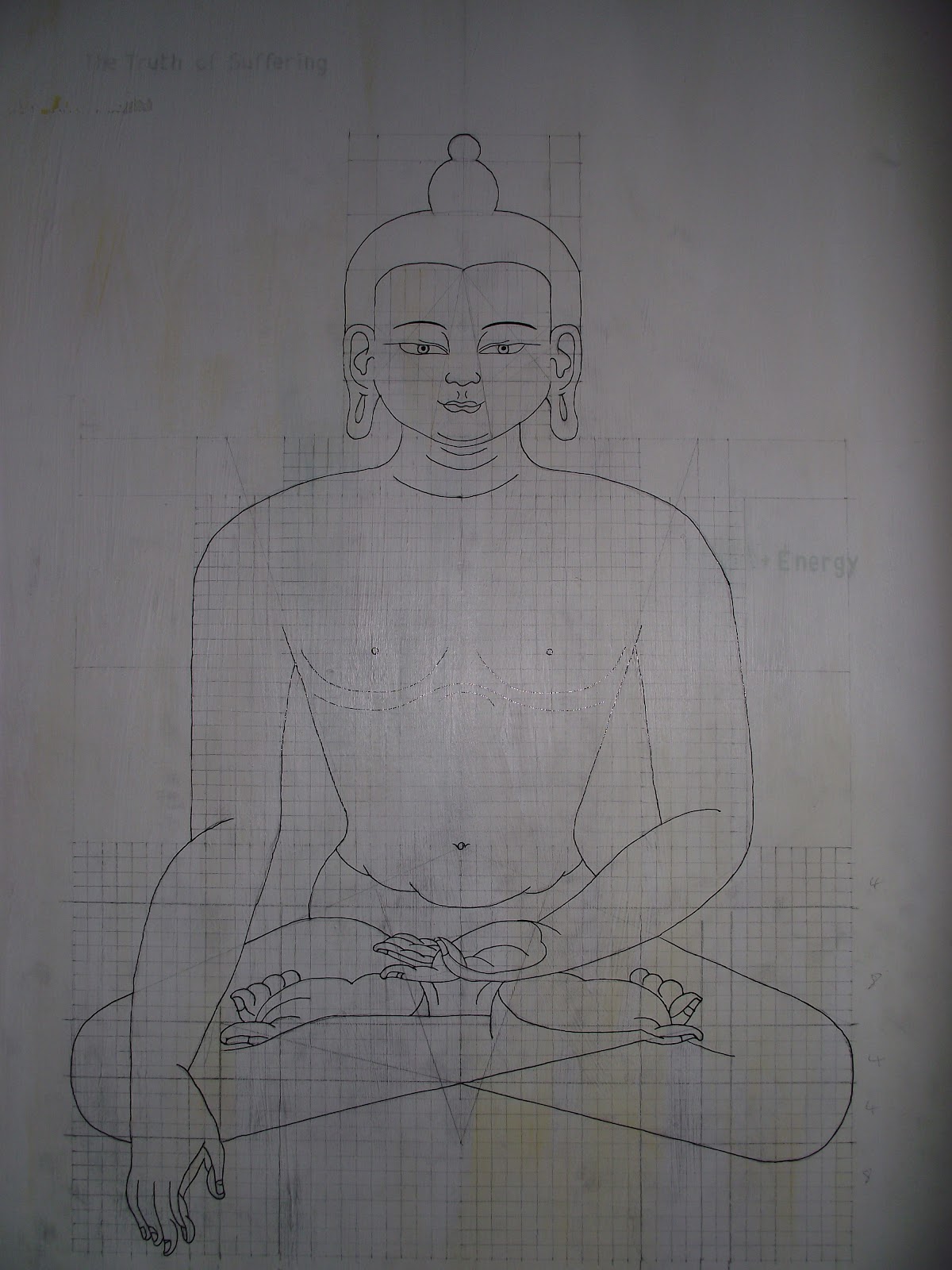
Evolution of a modern day Thangka


 (I'm painting this fella/dipingo lui)

I am currently painting a Thangka of the Medicine Buddha initially using traditional techniques with the intention to mix things up once the blue Buddha is in place and then modernize it thoroughly. I thought it might be nice to post the developmental stages as it requires patience and time to build up the image and the stages of development are so clearly demarcated. It is often said that painting a Thangka is a spiritual practice in itself and I can certainly attest to the fact that is requires intense concentration and presence to successfully utilize the traditional grid favoured by Tibetans, which you can see in the first pic.
Here are the first two pics:

Evoluzione di un Thangka moderna
Attualmente sto dipingendo un Thangka del Buddha della Medicina, inizialmente utilizzando le tecniche tradizionali con l'intento di mescolare le cose una volta che il Buddha blu è a posto. Ho pensato che sarebbe stato bello di ‘postare’ le fasi di sviluppo in quanto richiede pazienza e tempo per costruire l'immagine. Si dice spesso che dipingendo un Thangka in se è una pratica spirituale. Posso certamente attestare che richiede una concentrazione intensa e la presenza per utilizzare con successo il sistema di rete che potete vedere nella prima foto.
Qui ci sono le prime due foto:

 Pencil/Mattita

 Ink pen/penna con inchiostro

Monday, 23 April 2012

Mindfulness of Phenomena, Pt.2


(Ivo Stoyanov, Enlightenment)

 '(An) unchanging, unitary, autonomous self is non-existent. Our existence is nominal. Devoid of an owned, inherent nature.’ Allan Wallace.

‘All our anxieties and difficulties come from our inability to see the true face, or true sign of things.’ Thich Nhat Hanh

If Buddhism denies a permanent self, then how do we deal with the issue of identity? Who are we really? What is the basis of our sense of being ‘a somebody’ that does indeed appear to exist in the world - to have relationships, work, eat, sleep, piss about on Facebook and read Buddhist books? In Wallace’s words we are informed that there is not a permanent, fixed self; yet a self of some kind does exist, even if it is simply seen at first as the process of moving and shifting reference points, preferences, relationships and roles.
Initial questions in response to the teachings of no-self tend to emerge from the insecurity, doubt and fear that arises in response to the idea that no-self =‘I don’t exist’, when you quite clearly do. You’re reading this, right? Underneath such potential insecurities is the existential fear of non-existence, of being nothing and therefore believing somehow that there is no meaning in our existence. This is a fear I have experimented personally and I am fully aware of how unnerving it can be. However, no-self does not mean that we are merely a mass of biological processes, a cog in the wheel of organic life. Such perspectives on existence constitute a form of Nihilism, which is one of the great mistaken views in Buddhism. So, we can relax knowing that at least in Buddhism, this is not the intended meaning of no-self.
The questions should perhaps be then, not whether you exist, but ‘How do I exist?’ and ‘If there is no permanent central core within me somewhere, then what am I really?’ Discovering that a solid, core self is non-existent should not lead us to deny what we do wake up to each day. Our lives stand before us each morning. A tangible world that starts with our bed, the walls of our bedroom, the home that we inhabit, the street below, the feelings and sensations of warmth and of cold, and so on. The Buddhist path is not about denying life and existence. I like to think of it as the establishing of new rules of engagement and enquiry outside of our conditioned, patterned, personal history and collective blindness in order to see and experience things as they are, unconditioned. We are usually so driven to find final, definite answers that we often lose a sense of what the real issue is. Does it matter what we believe? Sure. Does it matter which position we adopt? Certainly. But do we need to be so concerned with getting the ‘right’ philosophical, religious or psychological belief, the final answer, to define ultimate reality or the end game of existence and life? No. At least I don’t believe so. To do so might simply be another mental construct we use to define our sense of self and position ourselves against, or for, a particular side in the endless debates about the true and ultimate nature of things. It is much more useful and relevant to explore directly the mechanisms within you that shape the reality you experience and live. In this way your personal experience takes precedence over the adoption of particular philosophical stances and the idea of no-self becomes an open invitation to explore the ramifications of such a possibility on your life, not only on the meditation cushion, but also in the moments in-between.

Whatever arises becomes a support for your meditation by providing an object of awareness; relaxing with the natural arising and falling of all phenomena leads to a panoramic mindfulness – rest there.

Identity is fluid and positional and in part it is a story that emerges through the large collection of experiences we’ve had up until now. These are accompanied by and interwoven with the stories we’ve taken on from family members, friends, school, university, religion and society, as well as the myths both individually formed and absorbed from the collective of the particular moment of history we are living through. The human world is centred on the need of a fixed self; we are supposed to be somebody with a clear identity, fixed clear needs, wants and desires. In our relationships we are expected to conform to a stable and reliable form and to behave in fairly predictable ways. We are supposed to vote for the left or the right, get a job and identify ourselves with the roles we take on through work and the building of a family unit. These elements form the structure within which our supposed self is expected to thrive and within which we are to be happy and fulfilled as a ‘productive member of society’.
The self that we conventionally invest in though does not exist and the mores of society are a house of cards. Have a look for a core within you that defines you and you’ll find it is missing in action. By that I mean search within your body, feelings, and mind for some essential element that is the core of your being and unchanging, not dependent to some degree on circumstances, and you will likely be disappointed. How do we go about doing this? A traditional Buddhist tactic is to break down phenomena into five parts called aggregates, and then examine them each for the illusive self.

(Sopheap Pich - Buddha)

There is no existing independently. You arise in accordance with phenomena.

Thursday, 12 April 2012

Mindfulness of Phenomena

 ('Jeez, are they gonna get this one?' Chagdud Tulku; great beard, great guy)

Wow! These posts keep getting longer and longer. This one will be divided into at least two parts, maybe three. If you're reading these that's either good news, or bad news. Take your pick and dive on in. This one's a good 'un. Comments are always welcomed and I'm still waiting for someone to complain about my freehand in dicing up more traditional approaches to presenting these core Buddhist teachings. Maybe you're the guy to start?

The fourth and final Foundation of Mindfulness is of phenomena. You might be asking yourself right now, ‘But aren’t the body, the feelings and mental activity phenomena too?’ and you would be right. This is an indicator of the way that the Four Foundations of Mindfulness function as progressive steps of integration of awareness within the totality of our individual experience. The idea that these Four Foundations exist separately is false. They are simply steps or stages of working with specific aspects of our experience. As with the previous three Foundations, Mindfulness of phenomena includes not only a resultant and integrative dimension, but also an active, volitional path of techniques and material to work through and integrate. And the key term is integration: when we have full awareness of the body, we have awareness of feeling and phenomena and the quality of mental states too. We break down perception into specific perceptual frames first, and then we build up an integrated perceptual outlook that is inclusive and cognisant of the interdependent nature of all phenomena within our field of perception. We work through the foundations individually because our experience of each of them is polluted by conditioning, patterned and therefore partial living, and our gross and subtle conceptualisation of experience.  

The volitional half of this fourth step involves working with quite an array of arenas and material. As per usual I shall try to discuss them in a more contemporary and accessible vernacular based on my own experience and insights, which are not authoritative, so don’t get your knickers in a twist if I seem a little brazen.
In order to start off on the right foot we need to establish a shared understanding of what is meant by phenomena. The Free Online Dictionary (A dictionary that sounds cut-price, but is actually great) defines it as:

1. An occurrence, circumstance, or fact that is perceptible by the senses.
2. An unusual, significant, or unaccountable fact or occurrence; a marvel.
3. In the philosophy of Kant; an object as it is perceived by the senses, as opposed to a noumenon (strictly mental or intuitive).
4.  An observable event.

The key point made by both dictionary and Kant is that phenomena is ‘perceptible by the senses’ and thus being observable, we can actually relate to it. It does not exist solely in our imagination or amongst our thoughts. Phenomena as experience do not exist solely in someone else’s imagination either, so we are dealing with experience and not theory. So, to make it extra clear: phenomena imply that which is perceptible and that which can be experienced through our five senses first hand.
The five senses are called doors because our relationship with the phenomenological world takes places through these doors of perception. Our perception works two ways; information comes in and our energy goes out and interacts with experience, flavouring the subjective nature of our interpretative tendencies. This applies whether it is sight, hearing, taste, touch or smell as they are a form of perception. They are multi-sensorial and layered that is to say our sense of relating to experience is built upon the accumulation of sensory data from a variety of our senses operating at different depths and levels.
Part of the art of ongoing practice is the expanding ability to break down experience into its seemingly individual elements and then integrate and harmonise those elements by allowing them to naturally co-exist. As a teacher of mine from the shamanic world once said, ‘Sure, it’s important to take apart Matthew, but it’s equally important to build.’ In a way she was reminding me in my more de-constructive days that our growth and evolution must mirror the natural tides of creation and destruction that mark the natural world which surrounds us. If we only allow for one of these primal forces to exists, we are denying the possibility for renewal to occur in practice and we are blinding ourselves to what impermanence means, which not only tells us that everything ends, but that everything is also born and this includes our breath, our blood cells, our thoughts, our feelings and pretty much everything else.
Followers of the earliest, remaining school of Buddhism, the Theravada, often leave a sense in their texts and practices of a highly de-constructive and reductionist approach to the Buddhist path that in my experience, at least so far, seems to lack something. What I find myself coming back to again and again with these blog posts is the need to embrace seeming opposites and contradictory approaches to relating to experience. Perhaps this is the famous Middle-Way that so often features in Buddhist speech? Form and emptiness are standard word play in Buddhist circles and yet within the essence of selflessness there is a pregnant space of bliss and fullness and I wonder how we can reduce that to the linguistic waste land of ‘emptiness’?
If we are to include the second of Free Dictionary’s definitions into the equation then we must be willing to assign all phenomena significance and thus worth our attention in the way of mindfulness. I would be tempted to leave aside ‘unusual’ but I don’t want to so I’ll give it the sense of ‘unique’ and add with ‘significant’ as a label for each moment of experience. We cease to make certain events special based on arbitrary valuation if we are willing to level the playing field of desirable phenomena. It’s important not to make that playing field a very large grey area.
Special becomes a form of favouritism that alienates or prioritises certain experience over others and this is actually a major part of the problem as far as suffering is concerned. Allowing the uniqueness of each unfolding moment of our day to be appreciated on its own terms opens up experience and the mundane gains greater worth and therefore potential, to lead to a ‘marvel’.
I will add that taking such an approach can be a useful strategy for initiating a deeper engagement with the world, when the time is right. We do not engage in a profound appreciation of their presence in our experience. I feel this body, and I know I am alive. I feel the sensations that make up my experience and I know I am alive. I am aware of my shifting moods, thoughts and states and I know I am alive. I feel a profound connection to all phenomena around me and I know I am part of the great web of experience that is life. This does not need to be romanticised or forced. It is a timely, natural arising of deep appreciation for the moments and days of our short existence in this body and in this life that runs counter to the impulsive urge to make experience something it has not yet become.
Thich Nhat Hanh demonstrates a profound and vivid understanding of the integrative approach through many of his books. His encouragement and instruction to smile at the parts of our body and welcome the connection to our past and future ancestors strikes me as profound, deeply human and wise.  It is, in many senses, a shamanic approach to understanding our place in human history; we are part of the great unfolding of the human experiment, linked through a long unbroken line of births and deaths that is our family lineage. Because life is so short, each moment must become profoundly important, and in making them so, our lives become both smaller in importance and greater in worth at the same time opening us to feeling our connection to all life.