Monday, 30 April 2012

Evolution of a modern day Thangka


 (I'm painting this fella/dipingo lui)

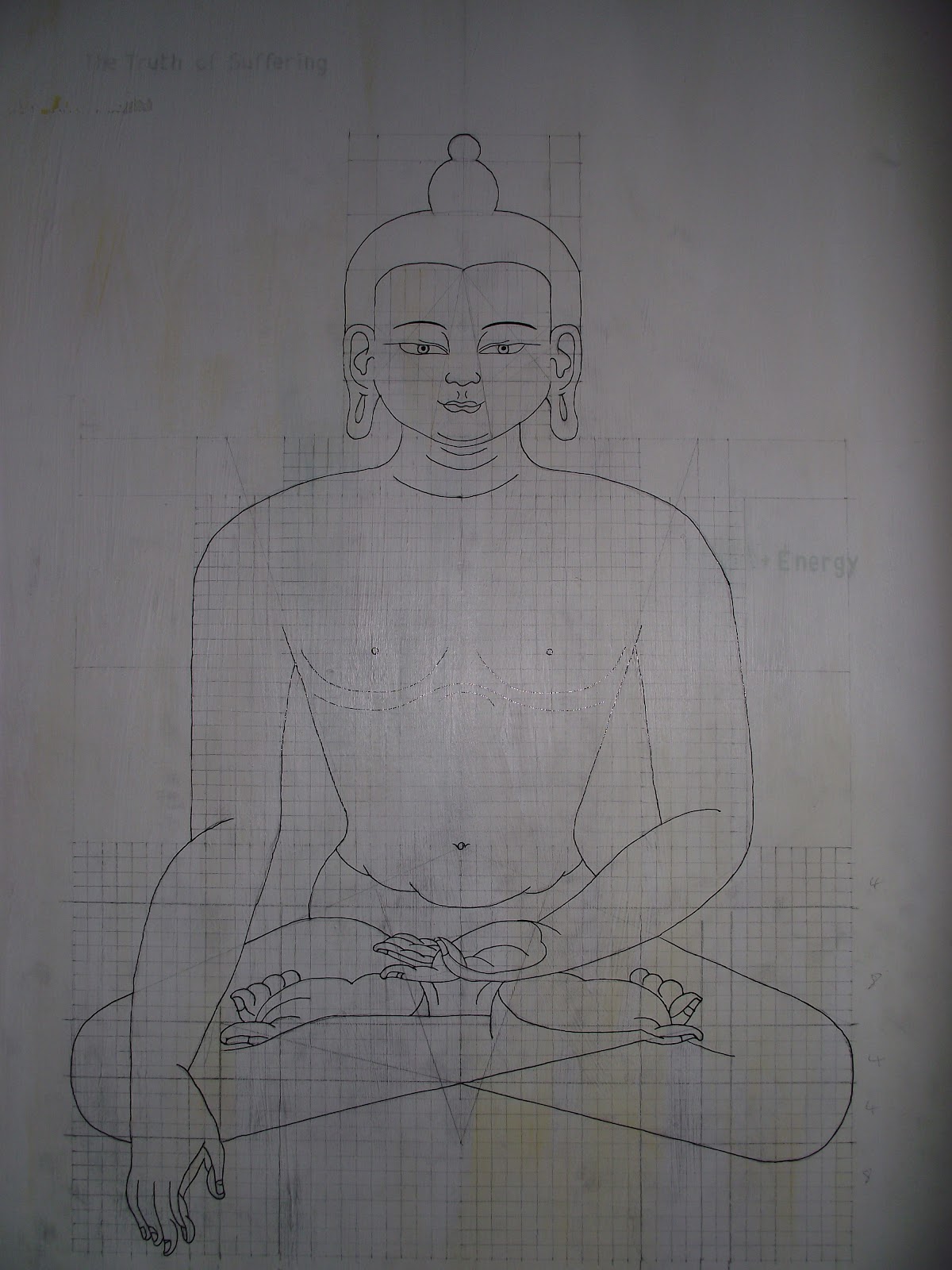
I am currently painting a Thangka of the Medicine Buddha initially using traditional techniques with the intention to mix things up once the blue Buddha is in place and then modernize it thoroughly. I thought it might be nice to post the developmental stages as it requires patience and time to build up the image and the stages of development are so clearly demarcated. It is often said that painting a Thangka is a spiritual practice in itself and I can certainly attest to the fact that is requires intense concentration and presence to successfully utilize the traditional grid favoured by Tibetans, which you can see in the first pic.
Here are the first two pics:

Evoluzione di un Thangka moderna
Attualmente sto dipingendo un Thangka del Buddha della Medicina, inizialmente utilizzando le tecniche tradizionali con l'intento di mescolare le cose una volta che il Buddha blu è a posto. Ho pensato che sarebbe stato bello di ‘postare’ le fasi di sviluppo in quanto richiede pazienza e tempo per costruire l'immagine. Si dice spesso che dipingendo un Thangka in se è una pratica spirituale. Posso certamente attestare che richiede una concentrazione intensa e la presenza per utilizzare con successo il sistema di rete che potete vedere nella prima foto.
Qui ci sono le prime due foto:

 Pencil/Mattita

 Ink pen/penna con inchiostro

Monday, 23 April 2012

Mindfulness of Phenomena, Pt.2


(Ivo Stoyanov, Enlightenment)

 '(An) unchanging, unitary, autonomous self is non-existent. Our existence is nominal. Devoid of an owned, inherent nature.’ Allan Wallace.

‘All our anxieties and difficulties come from our inability to see the true face, or true sign of things.’ Thich Nhat Hanh

If Buddhism denies a permanent self, then how do we deal with the issue of identity? Who are we really? What is the basis of our sense of being ‘a somebody’ that does indeed appear to exist in the world - to have relationships, work, eat, sleep, piss about on Facebook and read Buddhist books? In Wallace’s words we are informed that there is not a permanent, fixed self; yet a self of some kind does exist, even if it is simply seen at first as the process of moving and shifting reference points, preferences, relationships and roles.
Initial questions in response to the teachings of no-self tend to emerge from the insecurity, doubt and fear that arises in response to the idea that no-self =‘I don’t exist’, when you quite clearly do. You’re reading this, right? Underneath such potential insecurities is the existential fear of non-existence, of being nothing and therefore believing somehow that there is no meaning in our existence. This is a fear I have experimented personally and I am fully aware of how unnerving it can be. However, no-self does not mean that we are merely a mass of biological processes, a cog in the wheel of organic life. Such perspectives on existence constitute a form of Nihilism, which is one of the great mistaken views in Buddhism. So, we can relax knowing that at least in Buddhism, this is not the intended meaning of no-self.
The questions should perhaps be then, not whether you exist, but ‘How do I exist?’ and ‘If there is no permanent central core within me somewhere, then what am I really?’ Discovering that a solid, core self is non-existent should not lead us to deny what we do wake up to each day. Our lives stand before us each morning. A tangible world that starts with our bed, the walls of our bedroom, the home that we inhabit, the street below, the feelings and sensations of warmth and of cold, and so on. The Buddhist path is not about denying life and existence. I like to think of it as the establishing of new rules of engagement and enquiry outside of our conditioned, patterned, personal history and collective blindness in order to see and experience things as they are, unconditioned. We are usually so driven to find final, definite answers that we often lose a sense of what the real issue is. Does it matter what we believe? Sure. Does it matter which position we adopt? Certainly. But do we need to be so concerned with getting the ‘right’ philosophical, religious or psychological belief, the final answer, to define ultimate reality or the end game of existence and life? No. At least I don’t believe so. To do so might simply be another mental construct we use to define our sense of self and position ourselves against, or for, a particular side in the endless debates about the true and ultimate nature of things. It is much more useful and relevant to explore directly the mechanisms within you that shape the reality you experience and live. In this way your personal experience takes precedence over the adoption of particular philosophical stances and the idea of no-self becomes an open invitation to explore the ramifications of such a possibility on your life, not only on the meditation cushion, but also in the moments in-between.

Whatever arises becomes a support for your meditation by providing an object of awareness; relaxing with the natural arising and falling of all phenomena leads to a panoramic mindfulness – rest there.

Identity is fluid and positional and in part it is a story that emerges through the large collection of experiences we’ve had up until now. These are accompanied by and interwoven with the stories we’ve taken on from family members, friends, school, university, religion and society, as well as the myths both individually formed and absorbed from the collective of the particular moment of history we are living through. The human world is centred on the need of a fixed self; we are supposed to be somebody with a clear identity, fixed clear needs, wants and desires. In our relationships we are expected to conform to a stable and reliable form and to behave in fairly predictable ways. We are supposed to vote for the left or the right, get a job and identify ourselves with the roles we take on through work and the building of a family unit. These elements form the structure within which our supposed self is expected to thrive and within which we are to be happy and fulfilled as a ‘productive member of society’.
The self that we conventionally invest in though does not exist and the mores of society are a house of cards. Have a look for a core within you that defines you and you’ll find it is missing in action. By that I mean search within your body, feelings, and mind for some essential element that is the core of your being and unchanging, not dependent to some degree on circumstances, and you will likely be disappointed. How do we go about doing this? A traditional Buddhist tactic is to break down phenomena into five parts called aggregates, and then examine them each for the illusive self.

(Sopheap Pich - Buddha)

There is no existing independently. You arise in accordance with phenomena.

Thursday, 12 April 2012

Mindfulness of Phenomena

 ('Jeez, are they gonna get this one?' Chagdud Tulku; great beard, great guy)

Wow! These posts keep getting longer and longer. This one will be divided into at least two parts, maybe three. If you're reading these that's either good news, or bad news. Take your pick and dive on in. This one's a good 'un. Comments are always welcomed and I'm still waiting for someone to complain about my freehand in dicing up more traditional approaches to presenting these core Buddhist teachings. Maybe you're the guy to start?

The fourth and final Foundation of Mindfulness is of phenomena. You might be asking yourself right now, ‘But aren’t the body, the feelings and mental activity phenomena too?’ and you would be right. This is an indicator of the way that the Four Foundations of Mindfulness function as progressive steps of integration of awareness within the totality of our individual experience. The idea that these Four Foundations exist separately is false. They are simply steps or stages of working with specific aspects of our experience. As with the previous three Foundations, Mindfulness of phenomena includes not only a resultant and integrative dimension, but also an active, volitional path of techniques and material to work through and integrate. And the key term is integration: when we have full awareness of the body, we have awareness of feeling and phenomena and the quality of mental states too. We break down perception into specific perceptual frames first, and then we build up an integrated perceptual outlook that is inclusive and cognisant of the interdependent nature of all phenomena within our field of perception. We work through the foundations individually because our experience of each of them is polluted by conditioning, patterned and therefore partial living, and our gross and subtle conceptualisation of experience.  

The volitional half of this fourth step involves working with quite an array of arenas and material. As per usual I shall try to discuss them in a more contemporary and accessible vernacular based on my own experience and insights, which are not authoritative, so don’t get your knickers in a twist if I seem a little brazen.
In order to start off on the right foot we need to establish a shared understanding of what is meant by phenomena. The Free Online Dictionary (A dictionary that sounds cut-price, but is actually great) defines it as:

1. An occurrence, circumstance, or fact that is perceptible by the senses.
2. An unusual, significant, or unaccountable fact or occurrence; a marvel.
3. In the philosophy of Kant; an object as it is perceived by the senses, as opposed to a noumenon (strictly mental or intuitive).
4.  An observable event.

The key point made by both dictionary and Kant is that phenomena is ‘perceptible by the senses’ and thus being observable, we can actually relate to it. It does not exist solely in our imagination or amongst our thoughts. Phenomena as experience do not exist solely in someone else’s imagination either, so we are dealing with experience and not theory. So, to make it extra clear: phenomena imply that which is perceptible and that which can be experienced through our five senses first hand.
The five senses are called doors because our relationship with the phenomenological world takes places through these doors of perception. Our perception works two ways; information comes in and our energy goes out and interacts with experience, flavouring the subjective nature of our interpretative tendencies. This applies whether it is sight, hearing, taste, touch or smell as they are a form of perception. They are multi-sensorial and layered that is to say our sense of relating to experience is built upon the accumulation of sensory data from a variety of our senses operating at different depths and levels.
Part of the art of ongoing practice is the expanding ability to break down experience into its seemingly individual elements and then integrate and harmonise those elements by allowing them to naturally co-exist. As a teacher of mine from the shamanic world once said, ‘Sure, it’s important to take apart Matthew, but it’s equally important to build.’ In a way she was reminding me in my more de-constructive days that our growth and evolution must mirror the natural tides of creation and destruction that mark the natural world which surrounds us. If we only allow for one of these primal forces to exists, we are denying the possibility for renewal to occur in practice and we are blinding ourselves to what impermanence means, which not only tells us that everything ends, but that everything is also born and this includes our breath, our blood cells, our thoughts, our feelings and pretty much everything else.
Followers of the earliest, remaining school of Buddhism, the Theravada, often leave a sense in their texts and practices of a highly de-constructive and reductionist approach to the Buddhist path that in my experience, at least so far, seems to lack something. What I find myself coming back to again and again with these blog posts is the need to embrace seeming opposites and contradictory approaches to relating to experience. Perhaps this is the famous Middle-Way that so often features in Buddhist speech? Form and emptiness are standard word play in Buddhist circles and yet within the essence of selflessness there is a pregnant space of bliss and fullness and I wonder how we can reduce that to the linguistic waste land of ‘emptiness’?
If we are to include the second of Free Dictionary’s definitions into the equation then we must be willing to assign all phenomena significance and thus worth our attention in the way of mindfulness. I would be tempted to leave aside ‘unusual’ but I don’t want to so I’ll give it the sense of ‘unique’ and add with ‘significant’ as a label for each moment of experience. We cease to make certain events special based on arbitrary valuation if we are willing to level the playing field of desirable phenomena. It’s important not to make that playing field a very large grey area.
Special becomes a form of favouritism that alienates or prioritises certain experience over others and this is actually a major part of the problem as far as suffering is concerned. Allowing the uniqueness of each unfolding moment of our day to be appreciated on its own terms opens up experience and the mundane gains greater worth and therefore potential, to lead to a ‘marvel’.
I will add that taking such an approach can be a useful strategy for initiating a deeper engagement with the world, when the time is right. We do not engage in a profound appreciation of their presence in our experience. I feel this body, and I know I am alive. I feel the sensations that make up my experience and I know I am alive. I am aware of my shifting moods, thoughts and states and I know I am alive. I feel a profound connection to all phenomena around me and I know I am part of the great web of experience that is life. This does not need to be romanticised or forced. It is a timely, natural arising of deep appreciation for the moments and days of our short existence in this body and in this life that runs counter to the impulsive urge to make experience something it has not yet become.
Thich Nhat Hanh demonstrates a profound and vivid understanding of the integrative approach through many of his books. His encouragement and instruction to smile at the parts of our body and welcome the connection to our past and future ancestors strikes me as profound, deeply human and wise.  It is, in many senses, a shamanic approach to understanding our place in human history; we are part of the great unfolding of the human experiment, linked through a long unbroken line of births and deaths that is our family lineage. Because life is so short, each moment must become profoundly important, and in making them so, our lives become both smaller in importance and greater in worth at the same time opening us to feeling our connection to all life.

Friday, 23 March 2012

Mindfulness of the mind


With Mindfulness of the mind we are learning to recognise and acknowledge the whole range of mental formations as they arise in our experience. Feelings were defined as qualitative sensations of experience and are mental formations in themselves, but what constitutes mental formations exactly? They are the content and activity of the mind. The mind itself doesn’t exist as a separate entity, or permanent fixture, so we can only really know the mind by being conscious of its content. Consciousness allows us to be aware of mental formations. The mind then is understood as the flow of mental activity which is subject to frequent change.
The idea of the mind and consciousness can become complicated rather quickly and lead one down the road of philosophising. As these blog posts are primarily concerned with the experiential dimension of practice and enquiry, let’s accept for now that there is consciousness and there is content and that mindfulness here means bringing awareness and insight to the latter, which I have placed into categories below;

1.       Mental processes; thinking, imagining, fantasising, judging, reasoning, desiring, remembering, and forgetting, and so on. It includes mental formations such as beliefs, ideas, doubts, and views and more.
2.      The quality of attention and awareness; sharpness, drowsiness, sleepiness, distraction, concentrated, unconcentrated, open, curious, disinterested, scattered, cramped, aware, unaware, etc.
3.      Mental/emotional states; jealousy, irritation, annoyance, boredom, bliss, delusion, aversion,desire to harm, desire to help, excitement, etc.
4.      Emotional states; love, anger, fear, courage, empathy, compassion, etc.

Basically anything that you can define within personal experience is a mental formation of some form or other. Each has its own distinct form and flavour. None of them constitute a self or me and none of them are permanent. They have a duration and their intensity waxes and wanes. Some can be considered as explicitly positive and negative. Some are preferable to others. Some we covet and others we push away, or may not have met yet. In practising mindfulness the content is not so important. What matters is how you relate to it. The 7 factors of mindfulness remain the same as does our need to apply them to each of these phenomena as they arise in our everyday experience.
As I wrote for particularly pleasant feelings, mental formations can be highly addictive too. Practising mindfulness implies being with but not being within. As in the previous two arenas of practice, we develop the ability on the meditation cushion to observe, to experience, to allow to pass, the mental formations that arise within a given formal practice session.
In practising mindfulness of the mind we are generally guided to work with specific mental formations defined as positive or negative; though it’s probably more useful to think of them as being helpful or unhelpful. This removes some of the inevitable personalisation that tends to come with our favourite moods, emotions and thoughts. 


A fundamental approach to working with mental formations is simply to begin to recognise them as they appear and acknowledge their presence and this takes place both on and off the cushion. Being aware is the key element in all forms of mindfulness and is what allows us to engage with what constitutes our daily experiences with greater consideration. Acknowledging formations means identifying them as they are and leaving aside identification with the experience; if you experience anger for example, it is sufficient to say this is anger. By changing the personal pronoun ‘I’ to ‘this is’, we begin to weaken our association with the emotions and states we experience. We basically insert a little space between awareness and unfolding experience.  What we discover with time is that these mental states that we habitually experience are really mechanisms that separate us from naked experience.
On the cushion we can actively monitor states as they arise. It is a useful strategy for dealing with typical mental phenomena such as sleepiness, boredom, distraction, arousal, the strong desire to do something, and of course thinking and the results of thinking. Beginning meditators often don't realise that boredom, sleepiness and irritation are ripe fruit for practice and that they mark a great deal of our daily off cushion experience, or that we fill our lives up with busyness and activity in order to avoid those mental states.
If mindfulness is primarily a process of becoming aware and more present in our lives, then its deeper function of revealing the nature of things must be included as a natural deepening of practice. By acknowledging the content of our experience and removing the habit of referencing it back to an ‘I’ we can begin to allow mental formations to emerge without getting stuck to them. If for example anger arises and I hold that it is not a possession of mine, then anger is simply a response to a certain set of factors and is one of multiple options. In that case I have choice. Because by observing the nature of anger, how it begins, how it is a response to certain factors, how it builds, I can consciously choose to remove its causes, or I can simply remain with it as it arises and subsides without identifying with it. The latter can actually lead to profound insight into how we relate to anger and why we habitually relate to it in the manner that we do. This can be a liberating experience. To go one step further and see that anger is not an inherent response to particular experience and that it generally creates separation and an ‘us and them’ mentality, we can begin to realise that at the root of much of our anger is a need to shore up our defences against a perceived enemy and that behind our defences is a less than solid kingdom that we are mindlessly attempting to protect.
In developing consistency in mindfulness of the mind we start to see how mental formations are not so solid and that the typical range of mental formations we indulge in act as supports for a solid sense of self. In loosening the grip on these mental formations we start to see how helpful formations are also constructs and can be created if we so wish. It might be useful to consider helpful as that which reduces suffering. To respond to suffering whether personal or otherwise obviously becomes easier when we have developed the habit of holding on less tightly to the content of our experience.

Thursday, 22 March 2012

Let’s talk about sex...Buddhism Meet Shamanism (pt.5/1)


 ‘At Gotama’s enlightenment the earth shook like a woman in the throes of bliss; an all embracing cosmic orgasm that transformed human consciousness.’

Sex, sexuality, pleasure, and more. Sexuality is one of the most loaded, corrupted and confused areas of human experience. Sex is co-opted along with violence as the most effective vehicle for stimulating impulsive, mindless attraction and consumption of products and services that we may or may not need. Because of this subversion our ideas about sex and sexuality, and actual sexual experiences, are often invaded and polluted by external voices, messages and ideals, and fantasies abound in popular imagery defining, without our consent, what is attractive and unattractive, and  how we should or shouldn’t express ourselves sexually. What's more, organised religion continues to fight for the right to enter our bedrooms and preach to us about what constitutes sin and sexual misbehaviour in spite of its own history of sexual abuse and misconduct. The proliferation of news stories detailing the misdeeds of rapists, paedophiles and adulterers, and the umpteenth scandal of a teenage pregnancy come at us from our TV screens and from the front page of the local newspaper. The internet provides pretty much anyone with endless sexual images of all kinds imaginable with the vast majority featuring women with fake names, blown up breasts and lips, and invisible men who come on cue. If mine and previous generations had issues, it’s hard to imagine how the younger internet generation will emerge in an age in which recent figures have already made clear how screen obsessed, narcissistic and isolated young teenagers are.

‘Turn away from the enslaving pleasures of the senses. Sex is a raging fire that scorches and burns. Sex is karmically unwholesome’ (Some old Buddhist nonsense)

Sexuality has been incorporated into a wide range of religious forms and spiritual practices. It has been suppressed much more often though by each of the world’s religions and this includes Buddhism. It is not difficult to find material that lays out  clearly the lengths that organised religion has gone to in order to suppress sexual instincts and dictate what counts as acceptable sexual behaviour. Considering how backwards the majority of the world's countries are and how heavily influenced they  continue to be by religion, the issue of sexuality remains highly problematic, highly confused and highly polluted with exceedingly distorted images of what sex is and what it means to be a sexual man or a sexual woman.
Buddhism does not escape from this subversion. Early Buddhist orders were adamant that sex was the most evil of passions and the monastic orders prescribed a multitude of rules governing sexual restrictions including the condemning of masturbation: there were even specific rules put in place reminding nuns that they could not use vegetables to stimulate themselves sexually! More recently, the Dalai Lama has been known to champion archaic interpretations of Buddhist dogma informing us that oral and gay sex are bad sexual misconduct. Such nonsense you might think should have died a long, long time ago and yet one of the world's most respected holy men continues to spout such harmful, deluded rubbish.
Within Buddhism's history however, as John Stevens illustrates so well in Lust for Enlightenment, there is a whole range of ideas and approaches to sexual urges and primary desire ranging from extreme asceticism to unbridled, uninhibited sexual perversion.
There are multiple Buddhisms and a variety of attitudes towards sexuality can be found among them. A commonly held belief about monks and nuns is that they are rigidly celibate and somehow pure because of this. Within a variety of monastic traditions though it is possible for the ordained sangha to marry and raise families. It is typical for Zen priests to marry and this is also true for certain Tibetan monastic orders. As in Christian monastic orders, gay sex between monks was/is more common than you might think and occurred/occurs in Tibetan, Korean and Japanese seminaries and monasteries. Unfortunately, sexual abuse and the use of sexual favours to advance position continues to take place in hidden corners in hidden places. Kalu Rinpoche, a twenty-two year old Tibetan incarnation of a highly revered Tibetan, made a confessional video that he posted on YouTube to support his earlier revelations of sexual abuse, which he had suffered at the hands of monks when he was a child. This should act as a nail in the coffin of romanticised images of Buddhist monasteries as spiritually enlightened havens.

Saturday, 17 March 2012

Inizia un ciclo mensile di eventi sciamanici a Trieste: 1 aprile, 2012

Un lavoro Sciamanico, con cerimonie, insegnamenti, trasformazione, comunità, capanna di purificazione

 
Primo Incontro: L’Acqua

Si inizierà esplorando come l'elemento di acqua esiste sia dentro sia fuori; come essa si relaziona al nostro sé emozionale, e come può insegnare le verità profonde sulla nostra interrelazione con questa parte fondamentale del mondo e del nostro corpo. L'acqua ci insegna la capacità di divertirci e giocare nel mondo, fluire con la vita, condividere di più della nostra natura spontanea con gli’altri, come esprimere la nostra verità, e comunicare con il cuore aperto.
Impareremo nell’arco del giorno come muoversi in maniera più fluida attraverso le sfide ei cambiamenti della vita, e svilupperemo questa abilità attraverso insegnamenti, cerimonie individuali e di gruppo. La cerimonia della capanna purificazione completerà e ci aiuterà ad integrare una giornata piena di avventure ed esperienze.
Gli insegnamenti presentati provengono da un percorso sciamanico occidentale, la Sweet Medicine Sundance Path, e sono presentati su ruote di medicina. Elle sono delle mappe che mostrano l’interconnessione di questi insegnamenti con tutte le espressione delle vita e dell’universo.

Gli’incontri

Un evento Sciamanico avrà luogo ogni mese a quindici minuti, dal cuore di Trieste. Ogni incontro, svilupperemo un rapporto più consapevole e concreto con ciascuno dei cinque elementi in sequenza; acqua, terra, aria, fuoco, e vuoto, nelle loro espressioni energetiche e pratiche. Ciò avverrà attraverso gli insegnamenti sciamanici e cerimonie sciamaniche, fra cui il viaggio sciamanico, la cerimonia dell’albero fiorito, la capanna di purificazione, visualizzazione creativa, e la condivisione di e sostegno reciproco del gruppo .

Il primo incontro avrà luogo il 1° aprile. Non è uno scherzo però! Così, vieni a prendere parte ed esplorare maggiori possibilità di cambiamento e di crescita nella vostra vita attraverso la più antica delle pratiche spirituali.

Ogni incontro è dedicato ad un elemento, non è obbligatorio participare a tutti gli incontri quindi sentitevi liberi di venire a provare. Ci sarà un processo di sviluppo di tessitura che collehgerà insieme ogni incontro, per cui, coloro che sono aperti alla scoperta dei cinque elementi nella loro vita, hanno la possibilità di scorpire un rapporto crescente e profondo con ciascuno di essi. 


Tuesday, 13 March 2012

Mindfulness of the feelings


Part.1 Mindfulness: Introduction
Part.2 Mindfulness: the Body

Mindfulness of the feelings
‘Feeling is present at every moment of experience.’ Bikkhu Bodhi
What does it mean to feel? We often take feeling for granted, never really taking the time to investigate what is really going on when we say we feel this or that. We often fail to appreciate the richness, complexity, and also potential simplicity of the process of feeling, and yet, feeling marks each and every experience we have, have ever had, and will ever have. Our beliefs, ideas, self-image, are all infused with particular ranges of feelings and we use our feelings to judge whatever takes place both within and without as good, bad, or unimportant. For many, feelings are the gateway to truth, to authentic understanding and self-expression, whilst for others, especially my grandparents’ generation, feelings are unimportant, a form of self-indulgence, perhaps even weakness. 
Feeling leads to the formation of emotions, but feelings are not emotions. Feelings are the sensations we experience, and for mindfulness practice, they are the quality of sensation in the body and can be labelled simply as positive, negative, or neutral. This threefold category is traditionally applied to practising mindfulness of the feelings. That is we use our attention, our awareness, to observe how we have an impulsive tendency to react to feeling by labelling it as positive, negative, or neutral causing us to act accordingly. Feeling is rarely allowed to be as it is; instead it is subjectively made important, or unimportant. We charge feelings with meaning. Taking interpretation of what is felt as a determining factor in how we choose to go forward and act. Feelings actually function as an elaborate code through which we forge the direction our lives take.
Ultimately, separation between body, feelings, emotions, states and phenomena doesn’t exist. One flows into the other. They are profoundly interrelated. These categories though act as convenient method for defining experience and working with its more recognisable dimensions. The body feels for example, or rather we feel through the body, and emotions are felt within the body, and are accompanied by feeling. Emotions and other mental states are within the body, infused with feeling and directly related to phenomena. Our feelings are stimulated by the physical in the form of our body and the ‘external’ world. So, an important understanding to make clear here is that these four realms of experience are really not separate.
Initially mindfulness involves working with the four factors individually in order to understand how we are living, but we can also approach them as dimensions of experience that are to be integrated consciously each with the other as we proceed with practice. The problem and therefore motivation for separating them out is that our experiences are polluted with conditioning and confusion.  Working through these four arenas of mindfulness individually then helps us to clean up our internal debris. Once cleaned of patterning, reactivity and unspoken intentions we need to integrate and practice mindfulness of being, that is, the natural, naked embracing of experience in as total a manner as possible without manipulating or avoiding whatever naturally occurs. For some, this can emerge as initial practice. In my own personal experience the two ways of working are naturally related. My focus and intention of practice is integration of the arenas of being, but at times paying specific and careful attention to one of the four arenas of mindfulness can stimulate and facilitate opening further, or more deeply, to experience.
So, a central reason that we break mindfulness down into different objects of meditation is to gain clarity, understanding and insight into the nature of each and how one affects the other. Attempting to work with all of them together is too great a challenge for most people, and can be highly confusing. In part, this confusion arises because within the context of Right Mindfulness we are not just getting present, but seeking to develop direct insight into the nature of impermanence, interdependence and the lack of a separate, isolated self, and how they exist and play out as part of our own personal experience. As most of us haven’t yet awakened this knowledge within us, working with each object of mindfulness individually makes it easier to perceive directly and therefore to recognise and know these intrinsic aspects of reality for ourselves.


The commodification process I described regarding the body is also present with the range of feelings that we generally allow ourselves to experience. So much of our experience takes place within collectively normalised agreements on what it is okay and not okay to feel. Unconsciously, we measure the worth of our experience in relation to unspoken rules that define this narrow field of acceptable feelings held in place by the status-quo. Because the majority of what we feel is not at all unique, we can recognise it, with time, as conditioning that emerges from implicit, collective agreements that we have usually accepted unwittingly. The outlines of these agreements help us to define who and what we are, and who and what we are not. The edges come into play when we practice mindfulness of feelings, especially if we are willing to go really far/deeply with the practice. I would hazard a guess that for some of us, much of our extreme behaviour is a desire to break out of this conditioning, which is stifling, ultimately deeply unrewarding, and in Buddhist terms, a form of Dukkha.
To live a truly human existence is to embrace the whole potential field of feeling without fear, control or manipulation. For those with enough courage it can be quite a ride.
In working with feelings we are exploring the sensations within our body that accompany experience. We can get angry for example, but what are the actual sensations in the body that accompany anger? In working with the feelings we are brought face-to-face with our tendency to quantify and judge what we experience. Feelings are the basis of attraction and aversion and they tend to stimulate our decision-making in an impulsive manner. We act out very often in order to avoid experiencing certain feelings.
Mindfulness of feelings means becoming more conscious of how experience is saturated with interpretation and we can with time reduce our impulsive urge to jump to interpreting feelings, to simply allowing feelings to bring us in touch with where we are and with what is taking place. As we learn to acknowledge the simplicity of the body and connect more thoroughly, so we acknowledge feelings and let them be as they are.
On the cushion we can practice acknowledging feelings and recognise how we label them as pleasant, unpleasant and neutral, without trying to change them. There is an energetic response that is felt as a movement away or towards, an opening, or closing. This is the process of developing awareness. At this stage we can actively label what we are doing using the threefold system, or simply acknowledge what arises feeling how we experience it as pleasant, unpleasant or neutral.
Through developing consistency in this and allowing all manner of feelings to emerge, we begin to notice how we live through a constant stream of feeling and how this stream is constantly marked by our judgements. Going even further with this process we can begin to perceive how our feelings are intimately connected to the way we identify ourselves in relationship to the world. So, not, I think therefore I am, but, I feel, therefore I am. Yet, if you go further, you might observe that feelings are not you, and that you are not your feelings. And that what you believed yourself to be was held in place in great part by your interpretative relationship to feelings and your nurturing of specific feelings over others. 


On the cushion we develop the capacity to stay with feelings that are unpleasant, let go of holding onto or grasping at pleasant feelings, and give equal attention to neutral feelings, which is possibly the hardest part. This strengthens our capacity to be with all three without trying to manipulate one way or the other. Through this on the cushion practice we also strengthen our capacity to stay out of reaction when similar feelings come up throughout the day off the cushion. Underneath our labelling of experiences, and within these three categories, is naked experience as it is and without interpretation. To embrace experience in this naked manner, which lets go of the need to interpret and conceptualise, is an experience of deep and profound connection.
Our feelings are actually a great source of information and at times wisdom, especially when they become cleaned of our value judgements. In the shamanic realm, of which I participate actively, feelings connect us to the natural world and feelings are the basis for personal power. Through exploring feeling we are able to learn how to align with the movements of energy and change in the natural world. 
Feelings are not to be repressed or pushed away, and neither indulged in, and this is a good moment to talk about what it means to acknowledge experience without identifying with it.
ThichNhat Hanh talks of meeting experience with a smile. Ramm Dass uses a nice analogy of inviting both experience and neurosis in for a cup of tea. Both are playful indicators of the fact that in developing mindfulness there is energy involved; it is not a passive affair. Energy is present in meeting experience openly and allowing its presence to emerge, remain, and pass without interference. This points to the third factor of mindfulness; expressing appreciation for experience. By expressing appreciation for experience regardless of its impact on us, we disarm the power that a given moment and its accompanying feeling have over us. We don't fight and we don't try and force, we allow things to be and in doing so we allow them to leave. It is in a way similar to the movements of the tides, which come and go continuously, touching the shore intimately, expressing themselves at times with great force, with power and aggression, and at other times with gentleness and sweet caresses. The shore remains as a constant, present. It doesn’t run away because a tide takes a particularly challenging or uninviting form.